back
back

When purchasing prepackaged foods, people sometimes overlook the allergen information on the packaging, yet these seemingly brief words play a crucial role. This article is reproduced from a consumer reminder by the National Food Inspection Center to help everyone understand the allergen information on prepackaged food labels.
I. What Is Food Allergy?
Food allergy refers to an abnormal or excessive immune response caused by food proteins. Individual allergies vary. In mild cases, it causes rash, abdominal pain, and vomiting; in severe cases, it induces anaphylactic shock and endangers life.
II. What Are the Common Allergenic Substances?
The main allergenic substances that easily trigger human allergies include eight major categories: eggs and their products, gluten-containing cereals and their products, crustaceans and their products, fish and their products, peanuts and their products, soybeans and their products, milk and dairy products (including lactose), and tree nuts and their kernel products.
The new version of the National Food Safety Standard General Rules for the Labeling of Prepackaged Foods (GB 7718-2025) lists these eight major allergenic substances as mandatory labeling content, effective March 16, 2027. In addition, sesame, coconut, mango, etc., are voluntary labeling categories.
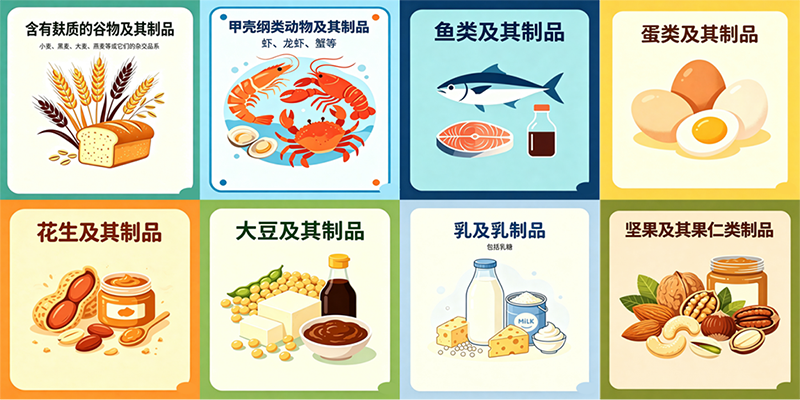
(Image generated by AI)
III. Daily Shopping Guide
Daily consumers can identify allergen information by reading prepackaged food labels.
1.Check the ingredient list. If allergenic substances are directly added as raw materials, they can be identified by checking the ingredient list, such as wheat flour in bread. Consumers need to pay special attention to hidden allergens in compound ingredients, such as eggs in mayonnaise and peanuts in peanut butter.
2.Check the statement column. Consumers should pay attention to allergen statements on food packaging, such as "Allergen statement: This product contains eggs, dairy products, soybeans" and "Contains milk, tree nuts, peanuts." They should also pay attention to the risk of trace cross-contamination due to shared production lines, such as the product statement "This production line also processes gluten-containing cereal products."
IV. Precautions for Allergic Individuals
The most effective way to prevent food allergies is to stay away from allergens and avoid eating them. It is recommended that allergic individuals proactively undergo allergen screening. For severely allergic individuals, trace allergenic proteins can induce severe discomfort. They should not eat foods they are allergic to and should cautiously consume foods with preventive statements such as "may contain XX." Mildly allergic individuals still need to pay attention to allergen risks, as initial contact with allergenic substances can also cause sudden allergies.

If symptoms such as itching and swelling of the lips or skin rashes occur after eating prepackaged foods, immediately stop eating and seek medical attention promptly.
Source: National Food Inspection Center