back
back

As a typical industry closely tied to people's basic livelihood needs, every move in the catering industry affects the pulse of China's economy. In the first half of this year, China's catering industry showed an operating trend of "stabilizing with progress, intensifying differentiation, and deepening transformation." National catering revenue reached 2,825.5 billion yuan, a year-on-year increase of 2.8%, 1.5 percentage points higher than the growth rate of total retail sales of consumer goods in the same period, accounting for 11.4% of total retail sales of consumer goods, and continued to play the role of a "ballast stone" in the consumer market. However, the overall industry growth rate has declined compared with previous years, leading catering enterprises have shown weak growth momentum, and the overall market remains under pressure.
"Looking ahead to the second half of the year, with the continued release of policy dividends such as the 2026 Work Plan for the Action to Improve Service Consumption Quality and Benefit the People and the 15th Five-Year Plan for Expanding Consumption, as well as the in-depth advancement of brand activities such as 'Chinese Cuisine Gala' and 'Healthy Consumption Season,' the catering market is expected to gradually stabilize and recover. However, the trend of shifting industry growth gears and reshaping the competitive landscape will not reverse, and catering enterprises need to prepare to 'fight a protracted war,'" said a relevant person from the China Cuisine Association.
I. Enterprises Above Designated Size Are Under Pressure, and the Industry's "Differentiation Effect" Is Obvious
Data recently released by the National Bureau of Statistics show that in June 2026, national catering revenue was 476.7 billion yuan, a year-on-year increase of 1.2%; catering revenue of units above designated size was 140.8 billion yuan, a year-on-year increase of 0.1%. From January to June 2026, cumulative national catering revenue was 2,825.5 billion yuan, a year-on-year increase of 2.8%; catering revenue of units above designated size was 832.8 billion yuan, a year-on-year increase of 1.8%.
From the monthly trend, catering revenue growth in the first half of the year showed a pattern of "high at first and low later, slowing month by month." January–February got off to a good start, with revenue of 1,026.4 billion yuan, a year-on-year increase of 4.8%; first-quarter revenue was 1,462.3 billion yuan, a year-on-year increase of 4.2%, 0.5 percentage points lower than the same period last year; January–April revenue was 1,888.3 billion yuan, a year-on-year increase of 3.8%; January–May revenue was 2,348.8 billion yuan, a year-on-year increase of 3.1%; and the cumulative growth rate in the first half further fell to 2.8%. The narrowing growth rate month by month reflects the wave-like characteristics of consumption recovery and the transformation of the industry's endogenous growth drivers.
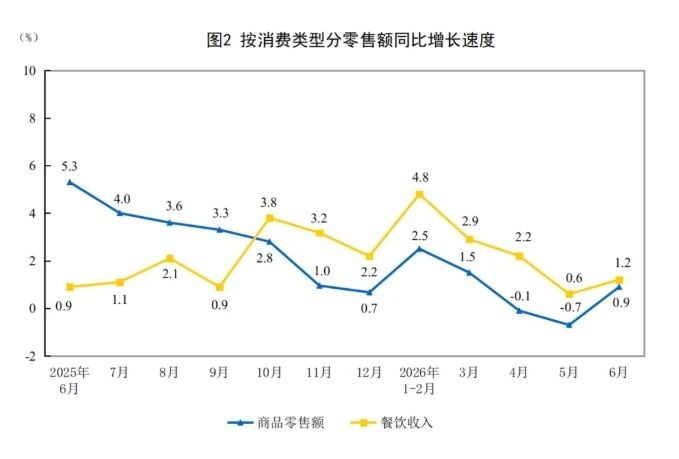
It is worth noting that the cumulative growth rate of catering enterprises above designated size in the first half was 1.8%, continuously lower than the overall industry growth rate, and the gap is widening. "This phenomenon shows that scale advantages do not necessarily translate into growth advantages," said a relevant person from the China Cuisine Association. Against the background of rigidly rising costs, intensified price competition, and increasingly rational consumer demand, some large-scale enterprises face pressures such as larger store volumes, longer management chains, and limited room for cost adjustment. At the same time, small and medium-sized catering enterprises also face greater challenges in customer flow acquisition, cost control, and risk resistance. Industry competition is further shifting from store number and scale expansion to single-store profitability, supply chain efficiency, product innovation, and refined operational capabilities, and the divergence in business performance among enterprises is becoming more obvious.
The China Catering Industry Performance Index Report released by the China Cuisine Association shows that in May 2026, the industry's overall performance index was 42.26, still below the neutral level of 50, meaning the industry has not yet emerged from the pressure range. "This shows that China's catering industry has completely bid farewell to the scale-driven incremental era and fully entered a high-quality development stock-leap era driven by quality, efficiency, and value," said a relevant person from the China Cuisine Association.
In the first half of this year, some large chain catering enterprises, because a big ship is hard to turn around, saw their profit margins extremely compressed and even fell into losses when facing the dual squeeze of rigidly rising rents and surging labor costs. However, in fierce stock competition, some enterprises with refined operational capabilities and supply chain advantages still tapped strong growth resilience.
II. "Catering+" Breaks Traditional Boundaries, with Healthification and Segmentation Developing in Parallel
"Catering+" cross-sector integration became the most prominent format innovation feature of the catering industry in the first half of this year. It is breaking industry boundaries and reconstructing business logic, with the core being to tap the "second growth curve" beyond catering.
The "catering + retail" model is accelerating its implementation. Leading brands such as Haidilao and Chayan Yuese have opened retail counters, relying on store traffic to develop pre-made snacks and souvenir products, breaking the limitations of offline dine-in operations and tapping additional brand revenue. "Catering + culture and tourism" continues to go viral. Camping hot pots and waterfront food pop-up stores rely on outdoor scenes to convert natural landscapes into catering consumption traffic. "Catering + technology" exploration is accelerating. Low-altitude drone delivery has entered community catering, opening a new track of "low-altitude economy + catering."
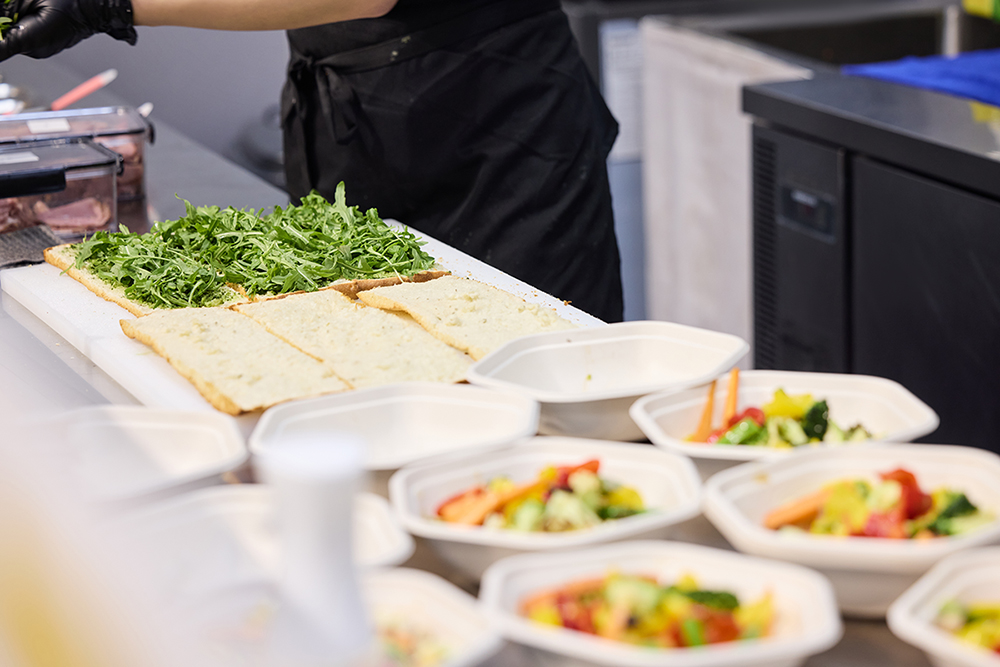
Healthy diets have upgraded from a marketing concept to an industry standard. Major chain brands are concentrating on light meals and low-fat dishes. Brands such as Micun Bibimbap, Domino's, and KFC have successively launched energy bowl series. Precision nutrition services are rising. Group catering enterprises rely on digital systems to build personalized nutritional meal standards, upgrading standardized meal supply to customized healthy diets. Fresh fruit seasonal new products continue to ignite online traffic. Tea beverage brands rely on seasonal fresh fruits to create limited-edition drinks and use seasonal content to drive social media heat.
Time-honored brands have completed upgrading and transformation by relying on cultural IP. Guangzhou Restaurant has built multi-level offline consumption spaces and created a youthful social IP; Yuyuan Catering has created immersive consumption scenes based on Eastern aesthetics; Tangshan Banquet has created a regional food culture landmark with a block-style real scene, giving catering stores dual attributes of catering consumption and urban cultural tourism. Community catering shows strong counter-cyclical resilience. Brands such as Ziguangyuan have created multi-format composite stores, relying on all-day operations and community private domain operations to deeply cultivate community customer sources, greatly improving operational stability. Immersive performance dining integrates multiple experiences of taste, audio, and visual, creating a new form of banquet through real-scene courtyards and plot narration.
In the first half of this year, consumption during various holidays fully released the industry's elasticity. During the Spring Festival holiday, the average daily sales of key retail and catering enterprises nationwide increased by 5.7% year on year. Survey data on catering industry operations during the May Day holiday show that the customer flow and operating revenue of surveyed catering enterprises increased by 4.2% and 3.1% year on year respectively; Wuhan's 3 million yuan crayfish consumption vouchers had 363,900 yuan redeemed in the first batch, directly driving 2.4603 million yuan in consumption, with a leverage ratio of nearly 1:6.8. Sales of regionally distinctive zongzi in many places soared, and traditional festival food consumption shifted from the north-south taste debate to a hundred flowers blooming of diverse flavors nationwide. The activity of the festival economy reflects the actual effectiveness of the "activities + scenes + consumption vouchers" combination under policy guidance, and also confirms the strong pull of deep integration of culture and tourism on catering consumption.
In this regard, industry experts said that in the face of the scissors gap between "declining income and rigid costs," catering enterprises are accelerating their transformation from "selling products" to "selling scenes and experiences." Cross-sector integration is no longer a novelty attempt, but an inevitable choice for seeking incremental growth.
III. The Industry Enters an "Era of Thin Profits," and Value Competition Becomes a Long-Term Strategy
The China Cuisine Association's analysis points out that beneath the surface data of consumption recovery, three deep-seated contradictions in the industry are becoming increasingly prominent.
First, the contradiction between revenue growth and profit erosion. The three monitoring indicators—sales index, employment scale index, and profitability index—show that "declining income superimposed on rigid costs" is continuously compressing corporate profit space. Rent, labor, and ingredient costs all remain high, and platform fees and traffic costs continue to rise. Small and medium-sized merchants are trapped in the dilemma of "no traffic if not participating, no profit if participating." Second, the contradiction between recovering confidence and cautious investment. Although the industry's quarterly expectation index has long remained above 50, the investment expectation index has fallen below and hovered under the neutral level. Enterprise expansion decisions have shifted from "occupying a position first" to "verifying first," and the single-store profit model has become a prerequisite for expansion. Third, the contradiction between market saturation and insufficient innovation. In the first half of the year, the number of newly registered catering enterprises nationwide fell by 17.3% year on year, but existing enterprises still exceeded 14.5 million. A large number of small and medium-sized merchants "lack funds, technology, and talent" in digital transformation and new product research and development, and can only follow leading brands and copy models, causing the industry to fall into "low-level repetitive competition."
In response to industry pain points, in the first half of 2026, the national level intensively issued more than ten heavyweight policies, launching a combination punch of "relief + regulation + incentives" to relieve difficulties and empower the industry. In terms of top-level design, the 15th Five-Year Plan for Expanding Consumption clearly requires "improving the quality of catering services, consolidating operators' primary responsibility for food safety, implementing a regional catering brand cultivation project, and encouraging localities to build food gathering districts and distinctive snack industry clusters." In terms of fiscal, tax, and financial support, the Ministry of Finance and three other departments issued the Notice on Optimizing the Implementation of Loan Interest Subsidy Policy for Service Industry Business Entities, raising the upper limit of interest-subsidized loans per household to 10 million yuan, with an annual interest subsidy ratio of 1 percentage point, effectively alleviating the funding pressure of small, medium, and micro merchants. In terms of digital and intelligent empowerment, the Ministry of Commerce, the National Development and Reform Commission, and six other departments issued the Implementation Opinions on Accelerating the Development of "Artificial Intelligence + Consumption," clearly promoting "smart canteens" in government organs, schools, hospitals, and other places, and promoting the application of intelligent equipment such as self-service meal pickup cabinets, intelligent recognition settlement systems, and self-service coffee machines. In terms of integrated innovation, the Ministry of Commerce, the National Development and Reform Commission, and others jointly issued Several Measures on Promoting the Integrated Development of Railways and Tourism to Expand Service Consumption, supporting brand catering and local specialty foods on trains.
Industry experts said that with the implementation of multiple consumption-promoting policies and the continuous carrying out of various catering consumption-promoting activities, the domestic catering market in the second half of the year is expected to steadily recover, but the reshaping of the industry landscape and slowing growth will become the norm. Catering practitioners need to take a long-term perspective, respond to industry changes through transformation and quality improvement, and prepare for refined, long-term operations.
Source: China Development and Reform