back
back

【Editor's Note】Food education is an important lever for building a solid food safety defense line, cultivating healthy lifestyles, and empowering the construction of a Healthy China. It is also an important vehicle for enterprises to practice social responsibility and convey the warmth of people's livelihood. As a national-level key activity of the 2026 National Food Safety Awareness Week, the Fifth China Food Education Conference was successfully held in Beijing. The conference brought together forces from government, industry, academia, and research, built a food education exchange and practice platform through a series of distinctive activities, and clarified the development direction and implementation paths of food education work in the new era. For many years, the Group has deeply cultivated the field of food education, practiced food education responsibilities, and actively promoted the implementation of food education concepts. To deeply study cutting-edge industry concepts and learn from high-quality practical experience, the following is a compilation of the conference's core viewpoints and achievements from all parties, providing reference and guidance for the Group to continue deepening food education construction and advancing innovative food education practices.
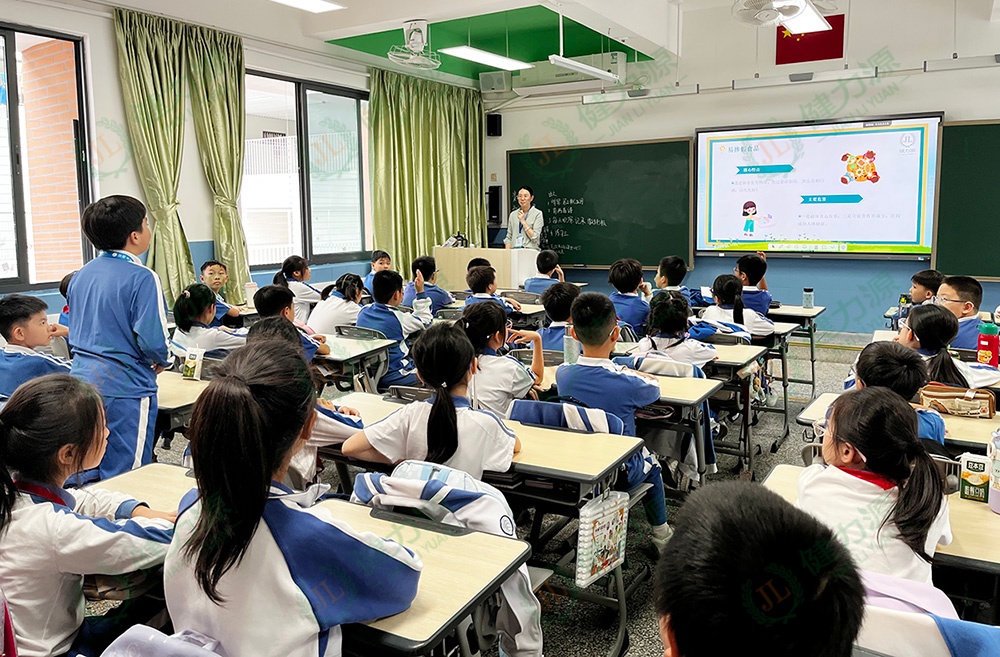
Jianliyuan Carries Out Food Safety Mini-Classes in Schools
I. Incorporate Food Education into the Overall Planning and Promotion of Healthy China Construction
Liu Xiaofeng, Vice Chairman of the 12th National Committee of the Chinese People's Political Consultative Conference, pointed out in his speech that through innovative working mechanisms and enriched communication methods, China's food education cause has initially formed a new food education work pattern of media leadership, home-school linkage, social coordination, and full-area coverage. He put forward three requirements: first, adhere to the strategic positioning and incorporate food education work into the overall planning and promotion of Healthy China construction; second, strengthen the construction of the food education teaching workforce and build a diversified teacher echelon of "full-time + part-time + specially appointed"; third, actively use new technologies to gather the synergy of social co-governance, promote the in-depth application of AI food education classrooms and digital food education platforms, and make the dissemination of food education knowledge more precise and efficient.
Chen Junshi, Academician of the Chinese Academy of Engineering and General Advisor of the National Center for Food Safety Risk Assessment, stated in his speech that food education is education for cultivating good eating habits and is an important component of a healthy lifestyle. Food education should start from children but also cover the entire life cycle. Different age groups face different nutritional needs and health problems, and each life stage requires targeted food education planning. Doing food education well must rely on co-governance: the government formulates policy guidance, experts provide scientific support, enterprises provide nutritious, healthy, and safe food, the media do a good job in science popularization, and schools and families implement daily education, truly reflecting that everyone is the first person responsible for their own health.
Ren Fazheng, Academician of the Chinese Academy of Engineering and Head of the National Expert Group on School Food Safety and Nutrition and Health, pointed out in his speech that China's health literacy level rose from 19% in 2019 to 33.69% in 2025, and food education has achieved remarkable results. Students are the core group of food education, and schools are the main front. Looking to the future, it is necessary to expand the food education pattern with the "Greater Food" concept, deepen the food education discipline construction system, strengthen food education scientific research, and provide practical support. Food education work requires multi-party linkage among the government, professionals, enterprises, and the public to establish a food education development system that conforms to China's realities and has Chinese characteristics.
II. Ministry and Local Exchanges: Policy Support and Grassroots Practice
At the conference, representatives from relevant ministries, localities, and enterprises exchanged views around policy support, local practice, and industrial empowerment of food education work.
Tian Jianxin, Director of the Department of Food Safety Standards, Monitoring and Assessment of the National Health Commission, put forward three opinions on food education for children and adolescents: food education is a foundational project for children's health and a required course for children's healthy growth; food education must clarify its goals and direction and be integrated into the school education system, with the core goal of cultivating healthy eating habits; food education requires multi-party coordination with each party fulfilling its responsibilities, building a working mechanism of government leadership, departmental coordination, school implementation, family participation, and social support. He introduced that the National Health Commission has successively issued documents such as the Guidelines for the Construction of Nutrition and Health Schools, revised the General Rules for Nutrition Labeling of Prepackaged Foods and the Nutrition Guidelines for Student Meals, cultivated a total of 148,000 nutrition instructors, and promoted nutrition instructors to enter schools, families, and communities.
Nie Dake, Deputy Director and First-Level Inspector of the Food Safety Coordination Department of the State Administration for Market Regulation, stated that food education is an important way to improve the scientific literacy of all sectors of society regarding food safety and strengthen food safety awareness from the source. He shared three understandings on food education work: adhere to consolidating the foundation and cultivating the essence, and promote the normalization and popularization of food education; adhere to multi-party linkage and build a full-area food education system; adhere to promoting intelligence through education and deepen food education empowerment for supervision. Food education must be deeply integrated with food safety supervision and industry self-discipline, guide food practitioners to operate in accordance with the law and with integrity, and empower food safety supervision to improve quality and efficiency with scientific food education.
Xie Haitao, Deputy Director of the Department of Physical Education, Health and Art Education of the Ministry of Education, stated that campus food safety and nutrition and health are "matters of national importance" and directly related to the healthy growth of hundreds of millions of students and the happiness of families. The Ministry of Education systematically advances the construction of five major systems: the campus food safety responsibility system, institutional system, supervision system, condition guarantee system, and emergency response system, and carries out a national special rectification of prominent problems in campus food safety and meal fee management in primary and secondary schools, bringing historic changes to the campus meal management system and mechanisms. Next, it will take rule-of-law, standardization, and informatization construction as the starting point, continue to deepen and consolidate the results of the special rectification of campus meals, and help campus food safety and food education work reach a new level.
Wang Fang, Member of the Education Working Committee of the Beijing Municipal Committee and Deputy Director of the Beijing Municipal Education Commission, introduced that Beijing is committed to building a school food education work pattern with capital characteristics: consolidating the institutional foundation, issuing the Food Education Guidebook for Primary and Secondary Schools, and compiling 3,040 recipes; innovating new educational carriers, piloting the construction of food education small journalist stations, promoting the construction of smart canteens and the transformation of the "central kitchen + mini kitchen" meal supply model; deepening home-school-community collaboration and forming a synergy of government leadership, departmental coordination, school implementation, family participation, and social support. In the future, it will continue to strengthen disciplinary integration, digital empowerment, and collaborative education, lighting up children's healthy future with food education.
III. Enterprise Empowerment: Food Education Exploration from Campus Meals to the Entire Industrial Chain
The advancement of food education is inseparable from the deep participation of food enterprises. From campus meals to the entire industrial chain, enterprises are becoming an important force in food education practice.
Yuan Haozong, Party Secretary and Chairman of Beijing Capital Agribusiness & Food Group, talked about that as the core carrier of food supply guarantee in the capital, Capital Agribusiness & Food Group adheres to the original mission of "food safety for the world, benefiting all households," takes demand as the to strengthen the main carrier of capital food supply, takes safety as the foundation to serve as the ballast stone of capital food safety, takes technology empowerment to build the main front of capital agricultural food innovation, takes brand soul-building to serve as the main force of capital food education promotion, and takes action to build a new platform for campus food education. The Group's "15th Five-Year Plan" strategic layout includes group catering business, establishing a professional campus meal catering service company and a comprehensive ingredient distribution company, preparing to build a campus meal safety and nutrition innovation center, and building a school-enterprise integrated food education + educational research platform.
Xu Ziying, Party Secretary, Chairman, and President of Bright Food Group, introduced that Bright Food Group has built the "Bright Future" campus meal brand, currently providing meal services to 450,000 teachers and students every day. Centering on the deep integration of food safety and food education, it is actively exploring three aspects of work: consolidating the meal supply foundation and building a solid quality foundation for campus meals with a full industrial chain system; improving the food safety defense line and creating a strong safety foundation for campus meal supply with full-process control; deepening food education integration and running nutrition science concepts and cultural care through students' daily lives with distinctive services. In the future, it is willing to join hands with colleagues from all sectors to jointly promote the high-quality development of campus meals and the food education industry.
Fang Ying, Deputy General Manager of Cooperation and Development of Taobao Flash Purchase, introduced that Taobao Flash Purchase has built a "three meals, five reductions" sustainable meal framework, starting from tableware, meals, and dining habits, and implementing plans for appropriate meal amounts, source reduction, intermediate packaging reduction, end consumption reduction, and low-carbon emission reduction. This year, it focuses on three food education directions: elderly assistance meals, rider caring meals, and small-portion meals, and jointly conducts nutrition research with the Institute of Nutrition and Health of the Chinese Center for Disease Control and Prevention, the Chinese Nutrition Society, and China Food Safety News. The platform hopes to take good care of the elderly, protect the young, and guide the small, implementing Healthy China into the practice of three meals a day.
IV. Expert Recommendations: Providing Theoretical Support and Implementation Paths for Food Education
Research institutions and local education departments respectively provided theoretical support, practical experience, and implementation paths for food education work from their own perspectives.
Liu Zhaoping, Director and Deputy Party Secretary of the National Center for Food Safety Risk Assessment, stated that food education is a key carrier for transforming food safety and nutrition and health policies into scientific literacy improvement, knowledge acquisition, and health promotion. He put forward three thoughts: consolidate the main front of school food education, incorporate food education into the entire process of the education system, and implement the concept that dining is a course and the plate is a textbook; create a social food education environment and build a large pattern of multi-party participation; activate a new engine for technology-enabled food education, use big data, artificial intelligence, new media, and modern technologies to precisely develop food education products and communication tools for different groups.
Liu Aidong, Director of the Institute of Nutrition and Health of the Chinese Center for Disease Control and Prevention, pointed out that nutrition is the foundation and important connotation of food education, and nutrition-enabled food education is a key lever for building a solid foundation for national health. Food education carries the diverse contemporary value of fostering virtue through education and is of great significance in the cultural, practical, ecological, and spiritual dimensions. Children and adolescents are the top priority of food education work, and childhood is the golden window period for shaping eating habits. Advancing the food education cause in the new era requires improving the institutional system, strengthening the teaching workforce, enriching educational resources, and gathering the synergy of families, schools, and society, so that the seeds of scientific eating take root and sprout on every dining table.
Wang Jieming, Deputy Director of the Jing'an District Food and Drug Safety Committee, Director of the District Food and Drug Safety Office, and Party Secretary and Director of the Jing'an District Market Supervision Administration, shared the grassroots practice of food education in Jing'an. Jing'an innovatively built the Shanghai Jing'an Food Safety Training Base, which restores high-risk food safety scenarios such as catering kitchens, farmers' markets, and fresh food supermarkets on a 1:1 scale. The district market supervision administration, together with China Food Safety News, the district education bureau, and the district health commission, jointly built the Shanghai Education General Station for Food Education Small Journalists, building a collaborative framework of professional media leadership, education and health foundation building, and market supervision empowerment, promoting food education from one-way indoctrination to systematic education.
Cheng Jingmin, Professor of Shanxi Medical University and Director of the Health Management and Policy Research Center, said that food education is like a seed, a lamp, and a bridge. He led his team over six years to conduct surveys of hundreds of thousands of people across 24 provinces and 70 counties, and found prominent problems such as insufficient vegetable intake and excessive oil and salt among residents. He suggested making food education a vivid footnote to "matters of national importance," promoting the deep integration of food education with the five educations of morality, intelligence, physique, aesthetics, and labor; letting food education take root and sprout in every meal, lighting up cognition with fun and awakening self-awareness with experience; letting food education become a warm transmission from life to life, and telling well the simple truth that food is a friend of life.
Article source: China Food Safety News